

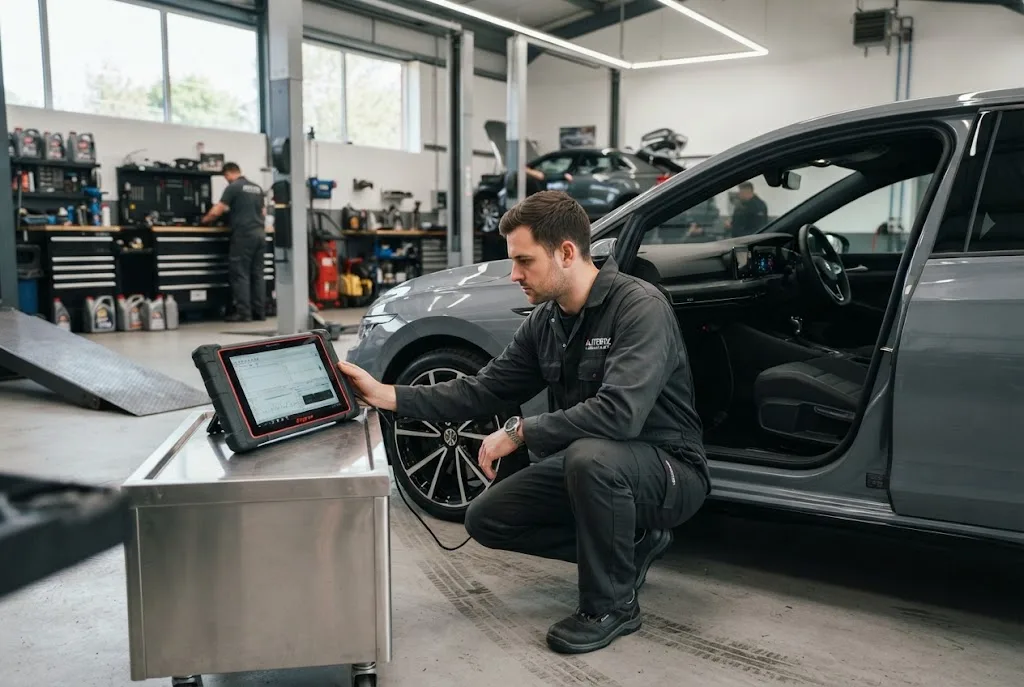
Auto diagnostic services help identify faults that may not be immediately visible during a routine vehicle inspection. Modern cars contain numerous electronic control systems and sensors that monitor engine operation, emissions, braking, safety systems and other functions. When a fault occurs, the vehicle may store diagnostic information that can help a technician identify the source of the problem.
Diagnostic testing can be particularly useful when a warning light appears, the engine behaves differently or a vehicle develops a fault that is difficult to identify through visual inspection alone. However, a diagnostic scan is not the same as a repair. The results need to be interpreted alongside the vehicle’s symptoms and physical condition. This guide explains how vehicle diagnostics work, what fault code reading involves, when engine diagnostics may be useful and what drivers should know about diagnostic checks.
What Are Auto Diagnostic Services?
Auto diagnostic services use specialised equipment to communicate with a vehicle’s electronic control units and retrieve information about detected faults. Modern vehicles can have multiple control modules responsible for different systems, depending on the vehicle’s design and equipment.
A diagnostic scan may retrieve stored or current fault codes and other information. A technician can then use this information together with the driver’s symptoms and additional testing to investigate the underlying problem.
The important point is that a diagnostic code does not necessarily identify the exact component that needs replacing. It provides information that can help guide the diagnostic process.
How Vehicle Diagnostics Work
Modern vehicles use electronic control units to monitor various operating parameters. Sensors provide information to these systems, which can then detect conditions that fall outside expected ranges.
When the vehicle identifies a problem, it may store a diagnostic trouble code. A compatible diagnostic tool can communicate with the relevant control system and retrieve available codes.
After retrieving the information, a technician may carry out further tests. These can include checking wiring, connectors, sensors, mechanical components and live data. The objective is to establish why the fault occurred rather than simply clearing the stored code.
When Should You Use Auto Diagnostic Services?
There are several situations where diagnostic testing can be useful. The most obvious is when a dashboard warning light appears. However, diagnostics can also support fault-finding when the vehicle develops unusual symptoms without displaying an obvious warning.
Common reasons for requesting a diagnostic check include:
- Engine warning lights
- ABS or other electronic system warnings
- Unusual engine performance
- Starting problems
- Unexpected changes in fuel consumption
- Intermittent electrical faults
- Rough running or hesitation
- Difficulty identifying the cause of a recurring fault
The correct diagnostic approach depends on the symptoms and vehicle. Some problems are primarily mechanical and may require physical inspection rather than relying on an electronic scan alone.
Engine Diagnostics Explained
Engine diagnostics focus on identifying faults that may affect engine operation and associated electronic systems. A diagnostic tool can retrieve relevant fault codes and, depending on the vehicle and equipment, provide access to live operating data.
Engine diagnostics may be useful when a car develops poor running, hesitation, reduced performance or an engine warning light. The information obtained can help a technician decide which components require further testing.
For example, a sensor-related fault code does not automatically prove that the sensor itself has failed. The sensor, wiring, connector and other related systems may all need to be checked before a repair is recommended.
What Is Fault Code Reading?
Fault code reading is the process of retrieving diagnostic trouble codes stored by a vehicle’s electronic systems. These codes are generated when the vehicle detects conditions that meet particular fault criteria.
Codes can provide valuable information, but they should be treated as part of the diagnostic process rather than a definitive repair instruction. The same symptom or code can sometimes have multiple possible causes.
A professional technician may therefore combine fault code reading with live data, electrical testing, physical inspection and manufacturer-specific diagnostic procedures.
This approach reduces the risk of replacing expensive parts unnecessarily simply because a particular code has appeared.
Understanding Dashboard Warning Lights
Warning lights are designed to alert drivers when a vehicle system requires attention. Different lights can indicate different levels of concern, and the exact meaning varies by vehicle.
An engine management warning light, for example, can be associated with a wide range of possible faults. ABS, airbag, battery and other warning lights can similarly require different diagnostic procedures.
Drivers should consult the vehicle handbook when a warning light appears and follow the manufacturer’s guidance. If the warning persists or is accompanied by noticeable changes in vehicle behaviour, professional assessment may be appropriate.
A warning light should not simply be switched off without investigating the underlying cause. Clearing a fault code does not necessarily repair the fault that caused it.
What Happens During a Vehicle Diagnostic Check?
A typical diagnostic process begins with gathering information about the problem. The technician may ask when the symptoms occur, whether the problem is constant or intermittent and whether any recent repairs or incidents could be relevant.
The vehicle can then be connected to appropriate diagnostic equipment. Available fault codes and system information are retrieved and reviewed.
Depending on the findings, the technician may perform additional tests. These could involve checking electrical circuits, sensors, mechanical components, fluid levels or other parts related to the fault.
The final repair recommendation should be based on the evidence gathered during this process. In some cases, the scan may identify a straightforward issue. In others, more detailed testing may be necessary.
Diagnostic Equipment and Modern Cars
Diagnostic equipment has become increasingly important as vehicles have incorporated more electronic systems. Basic code readers may retrieve limited information, while professional equipment can provide access to a wider range of vehicle systems and data.
The capability of diagnostic equipment varies significantly. Some tools are designed for broad compatibility across many manufacturers, while others are developed for specific vehicle brands or professional workshop applications.
Using appropriate equipment is important because not every diagnostic tool can access every system on every vehicle. Manufacturer-specific functions may also require specialist equipment or software.
Are Free Diagnostic Checks Reliable?
Some garages or automotive businesses advertise a free diagnostic check as part of a promotion or inspection. The exact meaning of a free check can vary, so drivers should ask what is actually included.
A basic scan may retrieve fault codes without providing a complete diagnosis. If further investigation is required, the business may charge for additional diagnostic time or testing.
Drivers should therefore distinguish between a free code scan and a complete diagnostic investigation. The latter may involve technical testing that requires additional time and specialist equipment.
Auto Diagnostic Services and Mechanical Repairs
Electronic diagnostics and mechanical inspection often work together. A diagnostic scan can provide information about electronic systems, while a technician may need to inspect physical components to confirm the cause.
For example, if a vehicle produces a warning related to its braking system, a diagnostic scan may provide electronic information, but physical components may also need to be inspected. Drivers can learn more about related brake services when investigating braking concerns.
Similarly, a vehicle that develops performance or handling issues after mechanical work may require both electronic diagnostics and physical inspection. Suspension-related symptoms, for instance, may require suspension repair rather than an electronic reset.
Diagnostics and Exhaust or Emissions Problems
Vehicle diagnostics can also be relevant to exhaust and emissions-related faults. Modern vehicles use sensors and control systems to monitor aspects of engine operation and emissions performance.
A warning light associated with an emissions system does not automatically mean that the exhaust itself needs replacing. Diagnostic information can help determine which part of the system requires further investigation.
Where physical exhaust problems are suspected, diagnostic testing can complement an auto exhaust repair inspection. The two approaches provide different types of information and may be used together.
Diagnostics and the UK MOT
Diagnostic testing can be useful when preparing to investigate vehicle problems, but it should not be confused with the MOT test. The MOT assesses whether a vehicle meets the required standards for the test at the time it is examined.
The official GOV.UK MOT guidance provides information about the MOT process and requirements.
A vehicle may require diagnostic work before or after an MOT if a fault is identified. Conversely, a diagnostic scan alone does not guarantee that a vehicle will pass its MOT.
Can Diagnostics Prevent Unnecessary Repairs?
Accurate diagnostic work can help reduce guesswork when a vehicle develops an electronic fault. Rather than replacing several components in the hope of finding the problem, a technician can use diagnostic information to narrow the possible causes.
However, good diagnosis still requires technical judgement. A fault code may point towards a particular system without identifying the precise failed component.
For this reason, drivers should be cautious of repair recommendations based solely on a code without supporting tests. Asking what was found, what was tested and why a particular repair is required can help make the process clearer.
How Much Do Auto Diagnostic Services Cost?
The cost of auto diagnostic services varies according to the vehicle, diagnostic equipment, complexity of the fault and amount of testing required. A basic code scan may be relatively straightforward, while an intermittent electrical problem can require considerably more diagnostic time.
Some garages charge a fixed diagnostic fee, while others may charge according to the time spent investigating the fault. Additional repairs and replacement components are normally separate from the diagnostic work.
Before authorising testing, drivers should ask what the quoted diagnostic fee covers. It is useful to establish whether the price includes only a scan or also includes technical investigation after codes have been retrieved.
Choosing a Diagnostic Garage
When selecting a garage, consider whether it has diagnostic equipment suitable for your vehicle and whether its technicians can investigate faults beyond simply reading codes.
A good diagnostic service should explain its findings clearly and distinguish between confirmed faults and possible causes. If a major component is recommended for replacement, the garage should be able to explain the evidence supporting that recommendation.
Vehicle-specific experience can also be valuable, particularly when dealing with complex electronic systems or faults that require manufacturer-specific diagnostic procedures.
Keeping Your Vehicle Healthy Between Diagnostic Checks
Diagnostic testing is useful when problems occur, but regular vehicle maintenance remains important. Drivers should follow the manufacturer’s servicing recommendations and pay attention to changes in performance, handling, braking and warning lights.
Other maintenance areas can also provide clues about vehicle condition. For example, unusual tyre wear may justify a wheel alignment check, while new braking symptoms may require a physical brake inspection rather than an electronic scan alone.
Keeping records of warning lights, symptoms and previous repairs can also help a technician diagnose intermittent problems more efficiently. Details such as when the fault occurs, engine temperature and driving conditions can sometimes be useful during the investigation.
When to Book Auto Diagnostic Services
Drivers should consider arranging auto diagnostic services when a persistent warning light appears, the vehicle develops unexplained performance problems or an electronic fault repeatedly returns.
A diagnostic check can provide useful information, but it is only one part of professional fault-finding. The most reliable approach combines diagnostic data with the vehicle’s symptoms, physical inspection and appropriate technical testing.
Understanding the difference between a free diagnostic check, fault code reading and a full diagnostic investigation can also help drivers choose the right service. A basic scan may be enough to identify where further attention is needed, while more complicated faults may require detailed testing.
For UK drivers, timely diagnosis can make vehicle problems easier to investigate and can help avoid unnecessary component replacement. When combined with routine servicing and attention to warning signs, professional diagnostics form an important part of maintaining a modern vehicle.
