

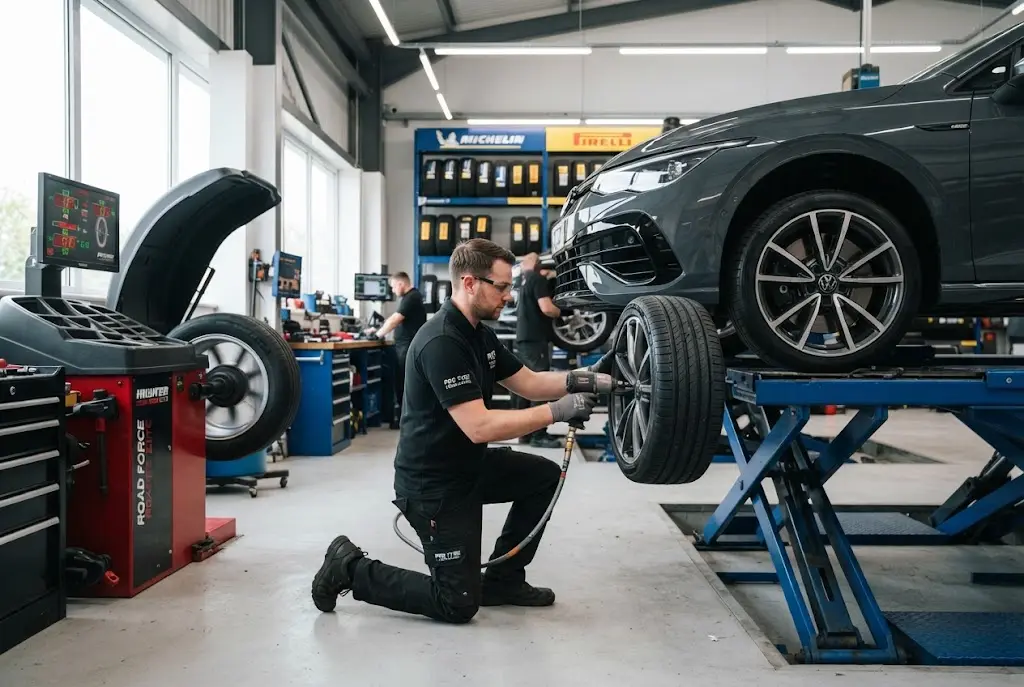
Understanding tyre services can help drivers make better decisions about maintenance, repairs and replacement. Your tyres are the only parts of your vehicle that remain in direct contact with the road, so their condition can affect braking, steering, grip, comfort and overall road safety. From routine tyre fitting and balancing to emergency repairs and mobile tyre fitting, different services are designed to deal with different problems.
This guide explains the main tyre services available to UK motorists, when each one may be needed, and what drivers should know about tyre pressure, tread depth and general tyre safety.
What Are Tyre Services?
Tyre services cover the inspection, maintenance, repair, fitting and replacement of vehicle tyres. A tyre specialist may assess the condition of a tyre, check its pressure and tread, repair certain types of puncture, fit a new tyre or balance a wheel after installation.
The exact service you need depends on the condition of your tyres and how your vehicle behaves on the road. For example, a slow puncture may require an inspection and repair, while a tyre with a damaged sidewall may need replacing rather than repairing.
Regular attention can also help identify problems before they become more expensive or create a safety concern. This makes tyre maintenance an important part of wider vehicle ownership, alongside servicing, inspections and other routine maintenance.
Tyre Fitting: What Does It Involve?
Tyre fitting is the process of removing an existing tyre from a wheel and installing a new one. Professional fitting normally includes removing the old tyre, checking the wheel, fitting the replacement tyre and inflating it to the appropriate pressure.
The fitting process matters because a tyre must be correctly mounted and inflated to perform as intended. After fitting, the wheel may also need balancing to help prevent vibration when driving.
Drivers should make sure they choose tyres that are appropriate for their vehicle. Size, load rating and speed rating can all matter, so it is sensible to check the vehicle handbook or obtain advice from a qualified tyre professional before buying replacements.
When Might You Need New Tyres?
Tyres may need replacing when they reach the end of their usable life, suffer damage that cannot safely be repaired, or develop excessive wear. Visible cracks, cuts, bulges or other significant defects should not be ignored.
It is also important not to wait until a tyre becomes illegal before considering replacement. The legal minimum tread depth for cars, light vans and light trailers in the UK is 1.6mm across the central three-quarters of the tread and around the entire circumference. Drivers should also consider the overall condition of the tyre rather than looking at tread depth alone.
Tyre Repairs: When Is a Repair Possible?
Tyre repairs can sometimes be used to deal with punctures or other minor problems. However, not every damaged tyre can or should be repaired. A professional assessment is important because the location and extent of damage can affect whether a repair is appropriate.
For example, damage to the sidewall can be more serious than a straightforward puncture in the repairable area of the tread. Continuing to drive on a visibly damaged tyre can also make the problem worse.
If you discover a nail, screw or other object in a tyre, avoid assuming that it is safe simply because the tyre still appears inflated. A slow puncture can cause pressure to fall gradually, potentially affecting handling and increasing tyre wear.
Signs You Should Have a Tyre Checked
- Repeated loss of tyre pressure
- A visible nail, screw or other object in the tread
- Bulges or lumps on the tyre
- Deep cuts or cracks
- Uneven tread wear
- Vibration or unusual handling
- A tyre pressure warning that keeps returning
If you are uncertain about the condition of a tyre, having it inspected by a qualified professional is safer than attempting to diagnose serious damage yourself.
Tyre Replacement: When Should You Consider It?
Tyre replacement becomes necessary when a tyre is no longer safe, legal or suitable for continued use. Low tread is one reason, but it is not the only factor. Damage, irregular wear and deterioration can also affect a tyre’s condition.
Replacing tyres before they reach the legal limit can provide an additional safety margin. TyreSafe notes that the legal minimum for car tyres is 1.6mm, while tyre safety guidance commonly encourages motorists to consider replacement before tyres become close to that limit.
When replacing tyres, drivers should also consider whether more than one tyre on the vehicle needs changing. Replacing tyres in pairs on the same axle may help maintain more consistent characteristics across that axle, depending on the vehicle and tyre manufacturer’s recommendations.
Why Is Tyre Balancing Important?
Tyre balancing helps distribute the weight of the wheel and tyre assembly more evenly. Small differences in weight can cause vibration, particularly at higher speeds, when a wheel is rotating rapidly.
During balancing, a technician uses specialised equipment to identify weight differences and makes adjustments using balancing weights. Correct balancing can help provide smoother driving and may reduce uneven wear caused by vibration.
If your vehicle develops a noticeable vibration through the steering wheel or body at certain speeds, wheel balancing may be one of the issues worth investigating. However, vibration can have several causes, so a professional inspection is useful rather than assuming balancing is automatically the solution.
Mobile Tyre Fitting Explained
Mobile tyre fitting allows a tyre professional to come to a customer’s chosen location rather than requiring the vehicle to be taken to a traditional tyre centre. Depending on the provider and circumstances, this may be available at home, at work or another suitable location.
This can be particularly convenient for drivers who have purchased replacement tyres online or who cannot easily visit a workshop. Some mobile services can also deal with certain punctures or emergency tyre problems.
Availability varies between providers, and not every tyre problem can be safely handled at the roadside. If a vehicle is stopped in a dangerous location, such as a motorway hard shoulder, drivers should prioritise their safety and follow official breakdown guidance rather than attempting a tyre change in a hazardous position.
Tyre Pressure and Why It Matters
Tyre pressure affects handling, grip, wear and the way a vehicle responds to steering and braking. Both under-inflation and over-inflation can create problems, which is why drivers should use the manufacturer’s recommended pressure rather than guessing.
The correct pressure can usually be found in the vehicle handbook and may also be displayed inside the fuel filler flap or on the driver’s door sill. Some vehicles have different recommended pressures depending on how heavily the vehicle is loaded.
TyreSafe recommends checking tyre pressures regularly, including before long journeys. A tyre pressure monitoring system can provide useful warnings, but it should not replace regular physical checks of tyre pressure and condition.
What Happens If Tyres Are Under-Inflated?
Under-inflated tyres can increase flexing, contribute to uneven wear and affect handling. They may also increase rolling resistance, which can affect fuel consumption. In addition, incorrect pressure can reduce the tyre’s ability to perform effectively in different road conditions.
What Happens If Tyres Are Over-Inflated?
Over-inflation can reduce the tyre’s contact area with the road and affect handling and braking. It can also contribute to accelerated wear in the centre of the tread. For this reason, simply adding more air is not a substitute for checking the manufacturer’s recommended setting.
Tyre Safety Checks Every UK Driver Should Know
Good tyre safety starts with simple, regular checks. Drivers should look at tyre pressure, tread depth and physical condition. TyreSafe recommends checking tyres at least once a month and before long journeys.
Look for cuts, cracks, bulges and objects embedded in the tread. Uneven wear can also provide a clue that something may need attention, such as wheel alignment or another vehicle-related issue.
The legal tread depth for cars, light vans and light trailers is 1.6mm across the central three-quarters of the tread and around the entire circumference. The Highway Code’s vehicle maintenance guidance also states that tyres must be correctly inflated to the vehicle manufacturer’s specification and free from certain cuts and defects.
It is worth remembering that a tyre can be unsafe even when its tread depth appears acceptable. Condition, pressure and damage all form part of the wider safety picture.
How Often Should You Use Tyre Services?
There is no single schedule that applies to every tyre service. Routine checks should be frequent, while professional services depend on the condition of the vehicle and tyres.
For example, tyre pressure can be checked regularly by the driver, while balancing may be needed after certain tyre or wheel work or when vibration develops. Repairs should be considered whenever a puncture or suspected damage occurs, and replacement becomes necessary when tyres are worn, damaged or otherwise unsuitable for continued use.
It is also sensible to check your tyres before long journeys, especially when carrying additional passengers or luggage. Correct pressure for the vehicle’s load can help maintain appropriate handling and tyre performance.
Choosing the Right Tyre Service
When choosing a tyre provider, look beyond the headline price. Ask what is included in the service, whether the provider can supply the correct tyre specification, and whether balancing or other associated work is included where appropriate.
For repairs, ask whether the tyre will be inspected before a repair is recommended. For replacement, confirm the tyre’s size and specification before installation. If you are considering mobile tyre fitting, check whether the service area and location are suitable for your situation.
Keeping records of tyre replacements and other maintenance can also make future vehicle ownership easier. When considering a used vehicle, tyre condition can form part of the wider assessment alongside a vehicle inspection and vehicle history check.
How Tyre Services Fit Into Overall Car Maintenance
Tyres are only one part of responsible vehicle maintenance, but they deserve regular attention because they directly influence how the car interacts with the road. A good maintenance routine combines tyre checks with servicing, inspections and timely repairs.
For drivers managing the cost of unexpected vehicle work, understanding repair finance can also be useful when a necessary repair or replacement creates an unexpected expense. Meanwhile, anyone considering buying another vehicle can research car finance and compare the overall running costs before making a decision.
Taking this broader approach can make vehicle ownership more predictable. Rather than waiting for a tyre problem to become urgent, regular checks can help identify pressure issues, uneven wear and visible damage earlier.
Final Thoughts on Tyre Services
Tyre services cover much more than simply buying and fitting new tyres. Tyre fitting, repairs, replacement, balancing, mobile services and routine safety checks all have a role to play in keeping a vehicle roadworthy.
Drivers should regularly check tyre pressure, tread depth and visible condition, while seeking professional advice when a tyre is damaged or its behaviour changes. Staying proactive can help prevent avoidable problems and support safer, more confident driving throughout the year.
