

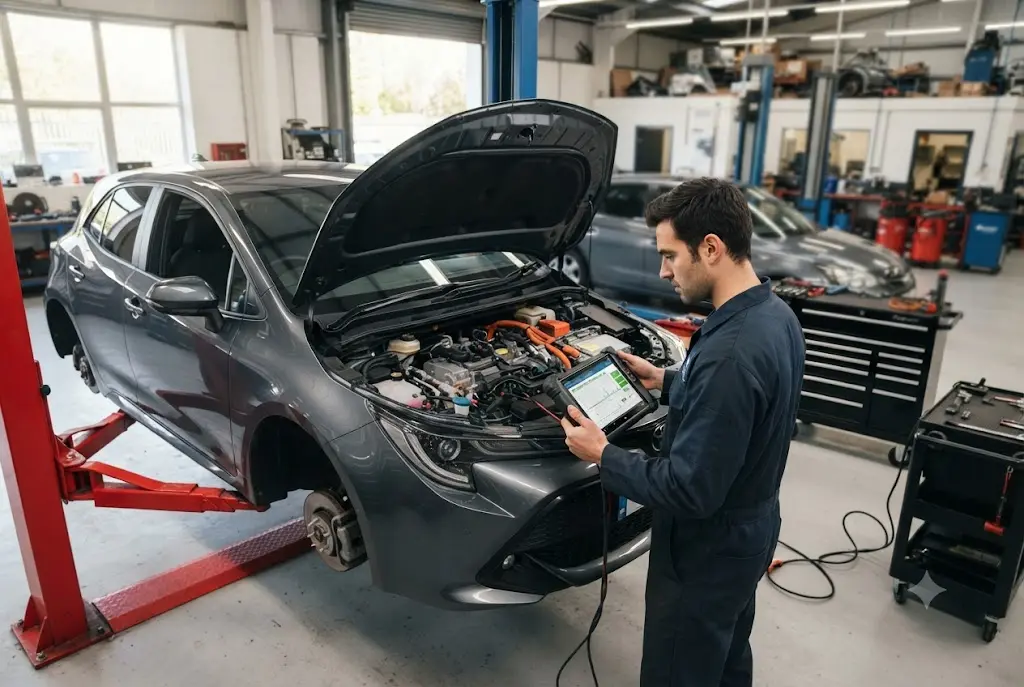
Hybrid servicing is an important part of keeping a hybrid vehicle safe, efficient and reliable on UK roads. Although hybrid cars combine an internal combustion engine with electric drive technology, they still require many of the routine maintenance checks associated with conventional vehicles. At the same time, their battery, electric motor and high-voltage components introduce additional considerations.
For owners, this means choosing a garage that understands both conventional mechanical systems and hybrid technology. The exact maintenance schedule varies by vehicle manufacturer, model and mileage, so drivers should always check their owner’s manual and manufacturer guidance. Understanding what hybrid services involve can nevertheless help you make better decisions when arranging routine maintenance or investigating a fault.
What Is Hybrid Servicing?
Hybrid servicing is the inspection and maintenance of a vehicle that uses both an internal combustion engine and an electric propulsion system. Depending on the model, a hybrid can use a petrol engine alongside one or more electric motors and a high-voltage battery.
Routine servicing can include conventional checks such as engine oil, filters, brakes, tyres, suspension and other mechanical components. However, technicians may also need to inspect hybrid-specific systems, including the battery, electrical connections, cooling systems and associated electronic controls.
The exact work depends on the vehicle. A self-charging hybrid and a plug-in hybrid may have different systems and maintenance requirements, so it is important to follow the manufacturer’s recommended schedule rather than assuming every hybrid needs the same service.
Why Hybrid Servicing Is Different
Hybrid vehicles have many components that are familiar from conventional cars, but their powertrain works differently. The electric motor can assist the petrol engine, while regenerative braking can recover energy that would otherwise be lost during deceleration.
Because of this arrangement, some components may experience different patterns of wear. For example, regenerative braking can reduce the amount of work performed by the conventional friction brakes in some driving conditions. However, that does not mean brakes, tyres or other safety-critical components can be ignored.
There are also high-voltage electrical systems that require appropriate knowledge, tools and safety procedures. The UK’s Health and Safety Executive notes that electric and hybrid vehicles can involve significantly higher voltages than conventional 12- or 24-volt vehicle systems and that specialist skills and equipment may be needed for safe repair and maintenance. Read the HSE guidance on electric and hybrid vehicles.
What Does Hybrid Servicing Include?
The contents of a service depend on the manufacturer’s schedule, the vehicle’s age and mileage, and the type of service being performed. Common areas of attention can include:
- Engine oil and oil filter replacement where applicable
- Air and cabin filter inspection or replacement
- Brake inspection
- Tyre condition and pressure checks
- Suspension and steering checks
- Fluid level inspections
- Cooling system checks
- Battery and hybrid system checks
- Diagnostic system checks
- Inspection of electrical components and connections
- Inspection of belts, hoses and other scheduled components
Not every service includes every item. Some components are replaced at specific intervals, while others are inspected and replaced only when required. A reputable garage should explain what is included before work begins.
Hybrid Battery Care and Maintenance
The hybrid battery is one of the most important differences between a hybrid and a conventional petrol or diesel car. It stores electrical energy used by the vehicle’s electric drive system and plays a central role in the hybrid powertrain.
Drivers should not assume that a hybrid battery needs to be replaced as part of routine servicing. In many cases, servicing focuses on checking the hybrid system and identifying potential problems rather than routinely replacing the battery.
Battery cooling is also important. Depending on the vehicle, the battery may use an air-cooling system or another cooling arrangement. Keeping relevant vents or intake areas clear according to the manufacturer’s instructions can help the system operate as intended.
Warning messages, unusual changes in performance or persistent hybrid-system alerts should not be ignored. A diagnostic assessment can help determine whether a problem relates to the battery, electrical system, sensors, cooling system or another component.
Toyota Hybrid Service: What Owners Should Know
Toyota hybrid service is a useful example of how manufacturers can incorporate additional hybrid checks into routine maintenance. The Toyota UK states that its Hybrid Service checks the hybrid system and hybrid battery, and that an annual qualifying Hybrid Health Check can provide additional battery cover under its current programme terms. :contentReference[oaicite:0]{index=0}
Toyota UK also currently states that its typical hybrid servicing interval is 12 months or 10,000 miles, whichever comes first, although owners should check the requirements for their specific vehicle because service intervals can vary. :contentReference[oaicite:1]{index=1}
This illustrates why manufacturer-specific information matters. A Toyota hybrid, for example, should be maintained according to Toyota’s recommended schedule, while another manufacturer’s hybrid may have different service intervals and inspection requirements.
Hybrid Maintenance Beyond the Battery
It is easy to focus on the battery when discussing hybrid vehicles, but good hybrid maintenance covers the entire vehicle.
The petrol engine still needs appropriate maintenance. Depending on the model, this can include oil and filter changes, cooling-system checks, spark plug replacement and other scheduled work. Tyres remain important because they affect braking, handling, efficiency and road safety.
Brakes also deserve attention. Regenerative braking can alter how the friction braking system is used, but brake discs, pads and related components still require inspection. A technician should assess their condition rather than assuming that reduced brake wear means they do not need maintenance.
Suspension, steering, wheel alignment and tyres are equally important. If you notice the vehicle pulling to one side or tyres wearing unevenly, a workshop may need to investigate the steering and suspension systems as well as checking the alignment.
Do Hybrid Cars Need Regular Oil Changes?
For hybrids that use an internal combustion engine, engine oil remains an important maintenance item. The electric motor does not eliminate the petrol engine or its lubrication requirements.
However, the engine’s operating pattern can differ from that of a conventional petrol car. It may switch on and off frequently as the hybrid system manages the balance between engine and electric power.
The correct oil specification and replacement interval should therefore come from the manufacturer’s service schedule. Using the right specification is more important than simply choosing an oil based on price or assuming that every petrol engine uses the same product.
Why Technician Training Matters
Hybrid vehicles contain high-voltage components that should not be treated like ordinary electrical systems. The Health and Safety Executive explains that technicians involved in hybrid and electric vehicle repair may need additional competence, training and suitable tools depending on the work being undertaken. :contentReference[oaicite:2]{index=2}
This does not mean every routine service requires a technician to work directly on the high-voltage battery. It does mean that a garage should understand the vehicle’s systems and know when specialist procedures are required.
When choosing a workshop, ask whether the technicians are trained to work on your particular type of hybrid. This is especially relevant if the vehicle has a warning light, battery fault, electrical issue or accident damage involving high-voltage components.
When Should a Hybrid Be Serviced?
There is no single service interval that applies to every hybrid. The correct schedule depends on the manufacturer, model, engine, powertrain and mileage.
Some manufacturers recommend annual servicing, while others may use different mileage or time intervals. Toyota UK, for example, currently recommends servicing most of its hybrids every 12 months or 10,000 miles, whichever comes first, while noting that certain vehicles can have different intervals. :contentReference[oaicite:3]{index=3}
The safest approach is to follow the service schedule in the owner’s manual and use the manufacturer’s official maintenance information when there is any uncertainty.
Signs Your Hybrid May Need Attention
Regular servicing is designed to prevent problems, but drivers should also pay attention to changes in how the vehicle behaves.
Potential warning signs include:
- A hybrid-system warning message
- Unusual engine noise
- Unexpected changes in fuel economy
- Reduced electric driving performance
- Unusual braking behaviour
- Warning lights on the dashboard
- Difficulty starting or switching between drive modes
- Unusual smells or overheating
- Changes in battery-related performance
One warning sign does not necessarily mean the hybrid battery has failed. Several components can cause similar symptoms, which is why proper diagnostics are preferable to replacing expensive parts based on guesswork.
Hybrid Repair vs Routine Servicing
Servicing and repair are not the same thing. A routine service follows a planned maintenance schedule, whereas a repair addresses a specific fault or failed component.
For example, a service may identify that a brake component is worn. Replacing it becomes additional repair work rather than simply another routine inspection. Similarly, a diagnostic check might reveal a fault within an electrical control system that requires specialist investigation.
If a garage recommends additional work, ask what has been found, why the repair is necessary and whether it is urgent. A clear explanation can help you distinguish routine maintenance from a genuine fault.
How to Choose a Garage for Hybrid Services
Not every workshop has the same level of hybrid expertise. When looking for hybrid services, consider several factors before booking.
Check Hybrid Experience
Ask whether the garage regularly works on hybrid vehicles and whether technicians have relevant training. Experience with one hybrid system does not necessarily mean the workshop is equally experienced with every manufacturer.
Ask About Diagnostics
Modern hybrids rely heavily on electronic control systems. A suitable workshop should have diagnostic equipment appropriate for the vehicle and understand how to interpret the results.
Check High-Voltage Capability
If the vehicle needs work involving the high-voltage system, confirm that the garage is appropriately equipped and trained for that type of repair.
Compare Service Specifications
When comparing quotes, check what is actually included. A cheaper service may not be directly comparable with a manufacturer-specific service that includes additional inspections or checks.
Keep Service Records
Maintaining a clear service history can make it easier to understand what has already been done and what is due next. It can also be useful when selling the vehicle or discussing warranty and manufacturer service programmes.
Can Independent Garages Service Hybrid Cars?
Yes, a hybrid does not automatically have to be maintained at a manufacturer’s dealership. An appropriately equipped and trained independent workshop may be able to service and repair many hybrid vehicles.
The important issue is capability rather than whether the garage is independent. Ask about the technician’s experience, diagnostic equipment and ability to follow the manufacturer’s service procedures.
This is also where the wider choice of garage networks can be useful. Some network-affiliated workshops have access to technical information and training that can support work on modern vehicles, although capabilities still vary between individual garages.
Hybrid Ownership and Long-Term Maintenance
Good hybrid ownership involves more than monitoring fuel consumption. Drivers should keep up with scheduled servicing, respond to dashboard warnings and follow the manufacturer’s recommendations for the hybrid system.
Regular maintenance can also help identify smaller problems before they become more complicated. Tyres, brakes, suspension, fluids and the conventional engine still matter, even though the vehicle also has an electric powertrain.
As hybrid technology becomes more common, drivers have more workshop choices. Nevertheless, specialist knowledge remains important when the work involves high-voltage components or manufacturer-specific systems.
Hybrid Servicing Costs
The cost of hybrid servicing varies according to the vehicle, manufacturer, service level, mileage and workshop. It is not accurate to assume that every hybrid automatically costs more to maintain than a conventional vehicle.
Some maintenance items can have different wear patterns because of the way the hybrid powertrain operates. At the same time, hybrid-specific diagnostics or specialist repairs can require additional expertise and equipment.
For example, Toyota UK currently publishes different fixed-price service levels for its vehicles, with prices varying by model category and service type. This demonstrates why owners should obtain a vehicle-specific quotation rather than relying on a generic hybrid servicing price. :contentReference[oaicite:4]{index=4}
Questions to Ask Before Booking Hybrid Servicing
Before handing over your hybrid, consider asking the garage:
- Do your technicians regularly service hybrid vehicles?
- Can you service my exact make and model?
- What is included in the hybrid service?
- Will the hybrid battery and electrical system be checked?
- Do you have suitable high-voltage safety equipment?
- Which parts and fluids will be used?
- Will you contact me before carrying out additional repairs?
- Will I receive an itemised invoice and service record?
- What warranty applies to the work?
Clear answers can help you choose a workshop that understands the requirements of your vehicle instead of simply treating it like a conventional petrol car.
Final Thoughts on Hybrid Servicing
Hybrid servicing combines familiar vehicle maintenance with additional checks for the electric powertrain and hybrid-specific systems. The petrol engine, brakes, tyres, suspension and fluids still require appropriate attention, while the battery and high-voltage components need technicians with suitable knowledge and equipment.
The best approach is to follow your manufacturer’s service schedule, use a workshop with relevant hybrid expertise and ask for a clear explanation of any additional repairs. Whether you choose a manufacturer-authorised centre, a qualified independent garage or a suitable network workshop, technical competence should be a priority.
As hybrid ownership continues to grow, understanding these maintenance requirements can help drivers protect their vehicles, identify problems earlier and make more informed decisions about servicing and repairs.
