

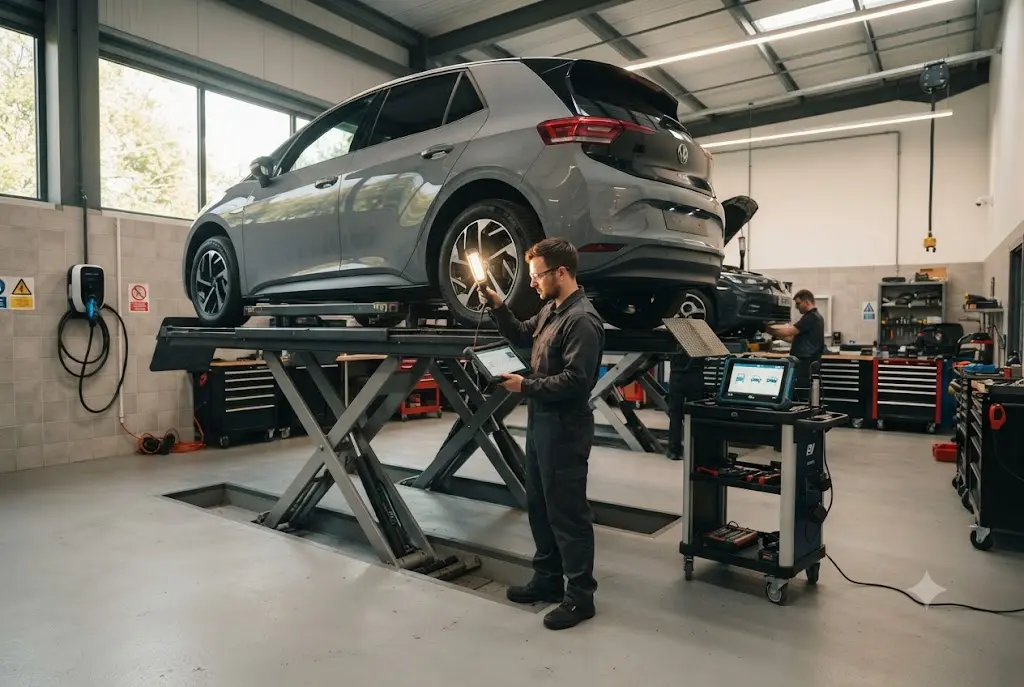
EV servicing is an important part of keeping an electric vehicle safe, reliable and suitable for everyday driving in the UK. Although fully electric cars have fewer conventional mechanical components than petrol or diesel vehicles, they still require regular checks and maintenance. Brakes, tyres, suspension, steering, fluids, charging equipment and electronic systems all need appropriate attention.
Electric vehicles also contain high-voltage battery systems and electrical components that require specialist knowledge when repair work goes beyond routine inspection. Choosing the right garage therefore matters. Drivers should consider the vehicle manufacturer’s maintenance schedule, the workshop’s EV experience, available diagnostic equipment and whether technicians have the appropriate skills for the work involved.
What Is EV Servicing?
EV servicing is the inspection and maintenance of a fully electric vehicle. Unlike a conventional car, an EV does not use a petrol or diesel engine, engine oil or a conventional exhaust system. However, that does not mean an electric car is maintenance-free.
An EV typically has a high-voltage traction battery, one or more electric motors, power electronics, charging equipment and a range of electronic control systems. It also has many familiar vehicle components, including tyres, brakes, steering, suspension, lights, windscreen wipers and safety systems.
The exact service requirements depend on the make, model and manufacturer’s schedule. Drivers should therefore use the vehicle handbook or manufacturer guidance to establish when servicing is due and what checks are required.
Why EV Servicing Is Different
Electric vehicles have a different powertrain from conventional cars, which changes the type of maintenance a technician may need to perform. There is no engine oil to replace and no exhaust system to inspect, but the vehicle’s high-voltage electrical architecture introduces additional safety considerations.
The Health and Safety Executive states that electric and hybrid vehicles can contain significantly higher voltages than conventional 12- or 24-volt vehicle systems. It also explains that repair and maintenance workers may need specialist skills, training, tools and equipment depending on the work being undertaken. Read the HSE guidance on electric and hybrid vehicle repair.
This does not mean every EV service involves working directly on the high-voltage battery. Many routine maintenance tasks can be carried out without accessing high-voltage electrical systems. The important point is that the workshop must understand the vehicle and follow appropriate manufacturer and safety procedures.
What Does EV Servicing Include?
The exact contents of an electric vehicle service vary between manufacturers and models. Common inspection areas can include:
- Brake condition and operation
- Tyre condition, pressure and tread
- Steering and suspension components
- Lights and external safety equipment
- Windscreen wipers and washer systems
- Brake fluid and other applicable fluids
- Cooling systems
- Charging equipment and connections
- High-voltage system checks where appropriate
- Vehicle diagnostics and software-related checks
- Cabin filters and climate-control systems
- 12-volt battery condition
Not every item will be inspected or replaced at every service. Some components have scheduled replacement intervals, while others are checked for wear or faults and replaced only when necessary.
EV Battery Maintenance Explained
The traction battery is one of the most important components in an electric vehicle. It stores the electrical energy used to power the motor and is generally much larger than the conventional 12-volt battery found in most vehicles.
EV battery maintenance does not normally mean routinely replacing the battery. Instead, maintenance can involve monitoring the battery system, checking for faults and ensuring associated cooling and electrical systems operate correctly.
Battery management systems continuously monitor aspects of battery operation. If the vehicle displays a battery warning, unusual charging behaviour or a significant change in performance, it should be assessed rather than ignored.
Drivers should also follow the manufacturer’s recommendations for charging and battery care. Different EVs can have different charging capabilities and battery-management strategies, so general advice should never override vehicle-specific instructions.
Do Electric Cars Need Regular Servicing?
Yes. An electric car still needs planned maintenance even though it has fewer moving powertrain components than a conventional vehicle.
The UK government advises vehicle owners that they are responsible for ensuring their vehicle remains roadworthy and states that the vehicle handbook provides information about when servicing is required. It also highlights routine checks such as tyres, brakes, lights and other safety-related components. Check the GOV.UK guidance on keeping your vehicle safe to drive.
Regular servicing can help identify wear and faults before they become more serious. It also gives technicians an opportunity to inspect components that may be overlooked if an owner assumes that an EV requires little maintenance.
Brakes and Regenerative Braking
Braking is an important part of EV maintenance. Electric vehicles commonly use regenerative braking, which allows the drivetrain to recover some energy during deceleration. This can reduce how frequently conventional friction brakes are used in some driving conditions.
However, regenerative braking does not eliminate the need to inspect brake discs, pads, callipers and related components. Brake components can still corrode, wear or develop faults.
Drivers should pay attention to changes in braking performance, unusual noises, vibration or warning messages. A qualified technician can determine whether an issue relates to the conventional braking system, regenerative braking or another component.
Tyres and Electric Vehicle Maintenance
Tyres remain critical on electric vehicles. EVs can be relatively heavy because of their battery packs, and the instant delivery of electric motor torque can influence how tyres are used.
Correct tyre pressure is important for handling, efficiency and tyre life. Drivers should use the manufacturer’s recommended pressures rather than assuming the figures used by another vehicle are suitable.
Uneven wear should also be investigated. It can sometimes indicate alignment, suspension or tyre-pressure issues. Our guide to wheel alignment explains why correct alignment matters when tyres are wearing unevenly or a vehicle does not track properly.
Charging System Maintenance
Charging system maintenance is another consideration for EV owners. The vehicle’s charging equipment and connections should be kept in appropriate condition and used according to manufacturer instructions.
If an EV repeatedly fails to charge, charges more slowly than expected or displays a charging-related warning, the problem should be investigated. The cause could involve the vehicle, charging cable, charging hardware, software or electrical supply rather than the traction battery itself.
Drivers should avoid attempting high-voltage electrical repairs themselves. The HSE states that high-voltage systems should be isolated and tested by appropriately competent people before relevant work is carried out. :contentReference[oaicite:0]{index=0}
For routine charging equipment issues, it is important to establish whether the fault is with the car or the charging installation. A qualified professional can help identify which part of the system requires attention.
EV Mechanics and Specialist Training
Choosing suitable EV mechanics is particularly important when a vehicle develops an electrical or high-voltage fault. Modern electric cars can have complex power electronics, battery-management systems, thermal-management systems and software-controlled functions.
The HSE identifies different levels of work involving electric and hybrid vehicles, ranging from lower-risk activities to maintenance, repair and work on high-voltage electrical systems. The level of competence required depends on the task being performed. :contentReference[oaicite:1]{index=1}
For this reason, drivers should ask a garage whether its technicians are trained to work on their particular type of EV. A workshop that can replace tyres or perform routine mechanical checks is not necessarily equipped to diagnose or repair a high-voltage electrical fault.
What EV Garages Should Have
There is no single piece of equipment that makes a garage suitable for every electric vehicle. However, the workshop should have the appropriate capabilities for the service it advertises.
Depending on the work, suitable EV garages may need:
- EV-compatible diagnostic equipment
- Manufacturer-specific technical information
- Appropriate high-voltage safety equipment
- Suitable insulated tools for relevant electrical work
- Trained technicians
- Safe procedures for isolating high-voltage systems
- Suitable lifting equipment and workshop facilities
- Knowledge of battery and thermal-management systems
Not every garage needs to offer high-voltage battery repair. For many routine services, what matters most is that the workshop understands the EV and knows when specialist intervention is required.
EV Repair vs Routine Servicing
It is useful to distinguish between servicing and repair. A service is normally planned maintenance based on the manufacturer’s schedule. A repair addresses a fault or damaged component.
For example, checking tyre condition during a service is routine maintenance. Replacing a damaged tyre after discovering a defect is repair or replacement work. Similarly, checking diagnostic systems is different from investigating a specific battery warning or charging fault.
If a garage recommends additional repairs, ask what has been found and whether the issue is urgent. Request a clear quotation before authorising work that was not included in the original service.
How Often Should an EV Be Serviced?
There is no universal servicing interval for every electric vehicle. Manufacturers establish their own schedules based on the vehicle’s design, components and intended use.
Some EVs use annual service intervals, while others may use mileage-based schedules or a combination of time and mileage. The most reliable source is therefore the vehicle’s handbook, manufacturer app or official service information.
Drivers should not use the absence of an engine as a reason to ignore scheduled maintenance. Brake, tyre, steering, suspension, cooling, electrical and safety systems still need appropriate inspection.
Signs Your EV Needs Attention
Regular servicing is important, but drivers should also respond to warning signs between scheduled appointments.
Potential signs that an EV needs inspection include:
- Battery or powertrain warning messages
- Unexpected loss of driving range
- Repeated charging failures
- Unusual noises from the drivetrain
- Changes in braking performance
- Reduced acceleration or power
- Unusual tyre wear
- Steering or suspension problems
- Overheating warnings
- Persistent electrical or dashboard warnings
These symptoms do not automatically indicate a battery failure. Several different systems can produce similar warning messages or changes in vehicle behaviour. Proper diagnostics are therefore preferable to replacing expensive components based on assumptions.
Can Independent Garages Service Electric Vehicles?
Yes, an independent workshop can be suitable for many EV maintenance tasks if it has the necessary knowledge, equipment and training. The key consideration is the garage’s actual capability rather than whether it belongs to a large automotive brand.
This can give EV owners more choice when looking for routine servicing, tyres, brakes and general mechanical work. Drivers can also consider suitable garage networks, where participating workshops may have access to wider technical resources and training.
For high-voltage electrical repairs or complex battery faults, however, it is particularly important to confirm that the workshop is competent to perform the specific work required.
EV Servicing Costs
The cost of servicing an electric vehicle varies according to its make, model, age, service schedule and the workshop used. It is not accurate to assume that every EV service will cost the same.
Electric cars generally avoid some maintenance tasks associated with combustion engines, such as engine oil and filter replacement. However, other areas can still require inspection or replacement, while specialist diagnostics and high-voltage repairs may require additional expertise.
When comparing prices, make sure quotations are based on the same service specification. Ask whether diagnostic checks, consumables, inspections and any scheduled replacement items are included.
EV Servicing and Garage Networks
The growing number of electric vehicles means workshops across the UK are adapting to new technical requirements. Garage networks can help participating workshops access training, technical information and equipment, although the capabilities of individual members can vary.
When choosing between a national chain, network garage, independent workshop or authorised service centre, focus on the exact work required. Our earlier guide to garage chains in the UK explains how major automotive chains differ and what motorists should consider before booking.
For an EV, technical capability should be considered alongside price, location and customer reviews. A convenient garage is not necessarily the right garage if it cannot safely perform the required work.
Questions to Ask Before Booking EV Servicing
Before booking an electric car into a workshop, consider asking:
- Do your technicians regularly work on electric vehicles?
- Can you service my exact make and model?
- What is included in the EV service?
- Do you have appropriate EV diagnostic equipment?
- Are technicians trained for high-voltage work if required?
- Can you investigate charging-system faults?
- Will you contact me before carrying out additional repairs?
- Which parts and consumables are included?
- What warranty applies to the work?
- Will I receive an itemised service record?
These questions can help establish whether a workshop is equipped for your vehicle rather than simply advertising itself as an EV garage.
EV Ownership and Long-Term Maintenance
Good electric vehicle maintenance is about looking after the entire car rather than concentrating only on its battery. Tyres, brakes, steering, suspension, cooling systems, charging equipment and safety systems all contribute to reliable everyday driving.
Drivers should also follow the manufacturer’s recommendations for charging, servicing and software-related updates. If a warning appears or the vehicle behaves differently, arranging an appropriate inspection is generally better than waiting for the next scheduled service.
The UK government’s guidance on electric vehicles also highlights the wider development of EV technology and charging infrastructure, reflecting how quickly the sector continues to evolve. Explore the UK government’s guidance on electric vehicles, costs and charging.
Final Thoughts on EV Servicing
EV servicing may be different from conventional car servicing, but electric vehicles still need regular maintenance. The absence of an engine and exhaust system removes some traditional service requirements, while introducing new considerations around batteries, charging systems, power electronics and high-voltage safety.
The best approach is to follow the manufacturer’s maintenance schedule and choose a workshop with the right experience for the job. Routine work can often be handled by a capable independent garage or network workshop, while high-voltage electrical repairs require appropriate specialist competence.
By comparing service specifications, asking about technician training and responding promptly to warning signs, UK EV owners can make more informed decisions about maintenance and repair throughout the vehicle’s life.
